
AI is Already in Enterprise Environments. Governance Cannot Wait.

Introducing FlyWheel Angel OS
The FlyWheel Angel OS Effect
A flywheel is a heavy disk or wheel rotating on a shaft so that its momentum gives uniform rotational speed to the shaft and to all connected machinery. In technology and business, a flywheel is a self-reinforcing feedback loop—a cycle in which early success feeds future progress. Borrowed from mechanics, it describes a system in which effort compounds over time.
FlyWheel Angel OS is being designed and built as a platform-agnostic, full-lifecycle AI governance operating system for enterprise AI and AI-augmented delivery. It is intended to connect approved business intent and requirements to bounded AI execution, review by a different model, accountable Human Decision Authority, release evidence, corrective work, and root-cause learning. Each validated correction strengthens future safeguards, helping improve delivery integrity, reduce recurrence and rework, and make enterprise AI more reliable, resilient, and valuable with every cycle.
FlyWheel operationalizes responsible AI across five connected domains:

1. Solution Architecture & Delivery Integrity
Aligns business intent, requirements, architecture, delivery, testing, release decisions, and outcomes.
2. Data Grounding, Context Alignment & Output Accuracy
Keeps AI work connected to approved business meaning, trusted data, traceable sources, and reliable outputs.
3. Security, Safety & Resilience
Applies identity, access, tool, connector, containment, recovery, and evidence requirements across enterprise boundaries.
4. Human-in-the-Loop & Decision Authority
Defines where Human judgment is required, who may decide, and what evidence supports approval, exception, release, correction, and re-entry.
5. Continuous Learning & Improvement
Turns validated findings, deviations, corrective work, regression results, and KPI signals into stronger governance.
The result is responsible, governed acceleration: ethical AI deployment, independently evaluated accuracy and compliance alignment, accountable Human decisions, and evidence-led continuous improvement.
One connected system
One connected system carries governed intent into action, proof, correction, and measurable improvement.
Built on Stewardship
Every Stage Governed — From Approved Requirement Through Correction and Back Into the Next Release.
FlyWheel separates governed execution, independent assurance, and Human Decision Authority while preserving one traceable evidence path.
FlyWheel Angel Agents perform approved work inside defined context, task, identity, tool, and permission boundaries. Separate auditor Agents evaluate the work against independent criteria and evidence obligations. Human Decision Authority is preserved over scope, architecture, access, exceptions, residual risk and release.

Customer-Configurable Governance Mechanisms
FlyWheel’s reusable governance core establishes consistent roles, authority, criteria, evidence obligations, and decision paths. Customer-configurable mechanisms add organization-specific policies, risk thresholds, approval rights, operating environments, and evidence requirements.
Human Decision Authority
Preserves Human Decision Authority over scope, architecture, access, exceptions, residual risk and release while AI accelerates analysis, execution and assurance, with traceable accountability from recommendation through production.
FlyWheel Root-Cause Analysis Intelligence & Continuous-Improvement Engine™
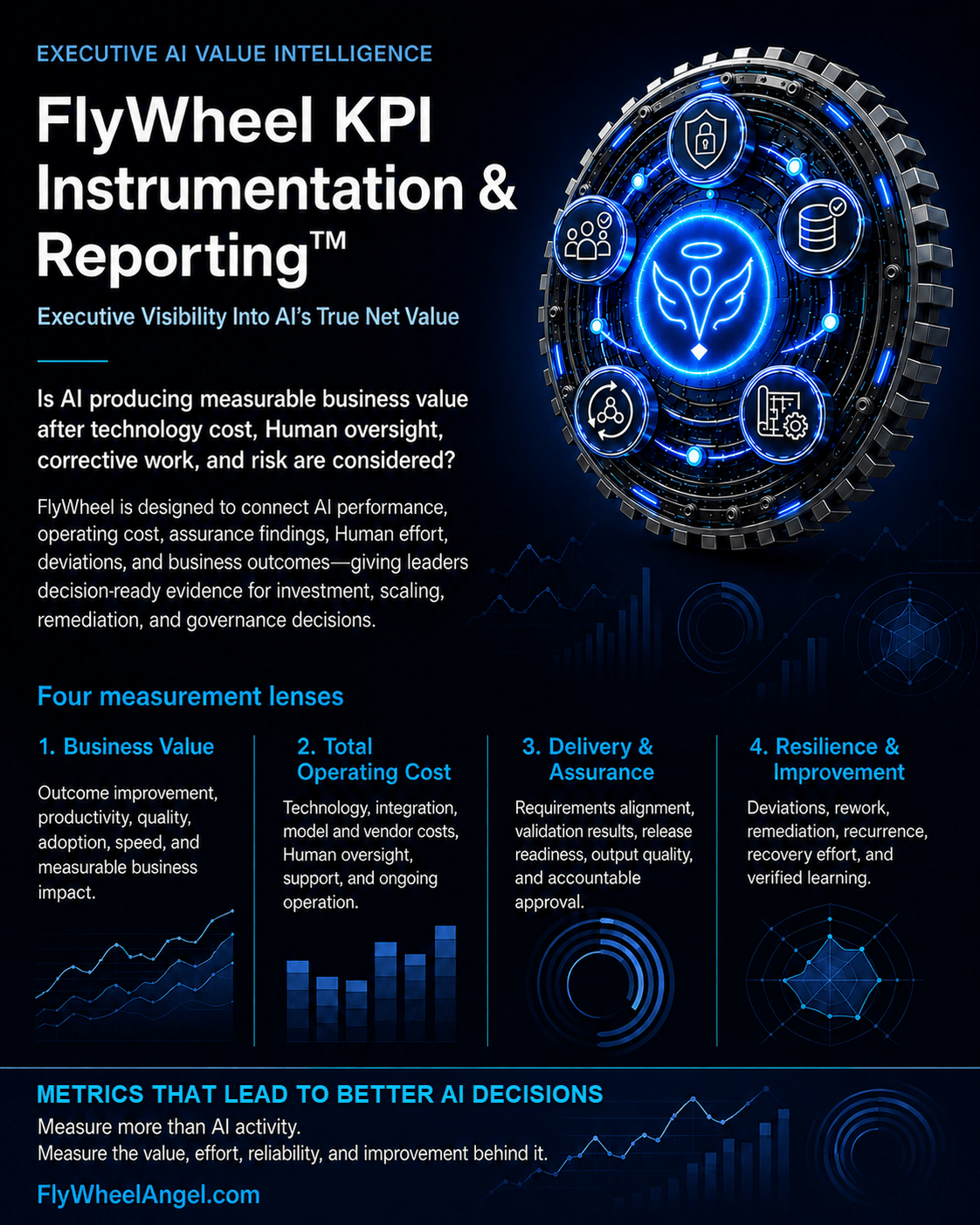
Validated deviations move through containment, accountable correction, independent retesting, and release or re-entry decisions. Root Cause Analysis Intelligence and KPI instrumentation turn the resulting evidence into stronger requirements, controls, tests, role boundaries, and governance modules.
AI expands execution capacity. Independent assurance, visible Human authority, and reviewable evidence preserve accountability for the outcome.
See How FlyWheel Governs the LifecycleFlyWheel RCA Intelligence
Introducing FlyWheel Root-Cause Analysis Intelligence & Continuous-Improvement Engine™ (RCA)
FlyWheel RCA reduces risk before execution, investigates and mitigates deviations when they occur, and converts validated lessons into stronger future guardrails that help reduce repeat failures and rework.
For each deviation, FlyWheel traces the root cause, validates an evidence-supported explanation, connects corrective work to independent retesting, and monitors behavioral drift and recurrence—carrying verified learning forward to strengthen the next cycle.


THE FLYWHEEL RCA LIFECYCLE
Five Connected Stages Turn Deviations Into Continuous Improvement

Prevent
Independent multi-model review and previously validated learning reduce risk before execution.

Investigate
Trace the root cause and validate an evidence-supported explanation when AI still deviates.

Mitigate
Correct affected work and independently retest the response. Where AI performs the retest, use a different AI model so the executing model does not certify its own correction.

Integrate
Apply each validated lesson to future guardrails.
Monitor
Track behavioral drift and recurrence.
NINE DEVIATION DRIVERS THAT MAKE RCA ESSENTIAL
Why AI Makes Mistakes—and Why Deviations Should Be Expected
Modern AI models are probabilistic, context-limited, dependent on changing information pipelines, and continuously revised after deployment.
Modern AI models can vary, lose context, change after deployment, encounter new conditions, and act on flawed information.
The following are nine deviation drivers that make continuous RCA essential:
Probabilistic by Design
AI Predicts Likely Outputs—Not Fixed Outcomes
The Explanation:AI models use probability distributions to predict each next token, response, or action rather than following one fixed logical path.
Impact:Because multiple outcomes can be statistically plausible, the same input can produce different answers, recommendations, or actions across separate runs.
- Structural Hallucinations
- Contextual Misalignment
- Output and Decision Variance
Rapid AI Model Changes
Rapid Model Revisions Can Silently Alter AI Behavior
The Explanation:AI providers update production systems at software speed—deploying changes every few days, refreshing models every few weeks, and retiring versions within months.
Impact:Enterprise AI operates on infrastructure that continuously changes—even when the enterprise has not changed its prompt, requirement, or approval.
- Performance and Behavior Drift
- Regression Failures
- Guardrail Over-Correction
- Unsafe Recommendation
Context Window Degradation
Long Interactions Can Lose Critical Context
The Explanation:As conversations and data inputs grow, AI may compress, truncate, or shift attention away from instructions and evidence provided earlier in the interaction.
Impact:Later outputs can overemphasize recent information while losing requirements, decisions, and boundaries established at the beginning.
- Instruction and Constraint Loss
- Cascading Logic Errors
- Recency Bias
Distribution Shift
The Real-World Moves Beyond the Training Data
The Explanation:AI models apply statistical patterns learned from historical training data to current inputs.
Impact:Without fresh context, AI can keep applying yesterday’s patterns after the real world has moved on—increasing the risk of outdated, biased, or unreliable decisions.
- Outdated Recommendations
- Edge-Case Failures
- Bias Amplification
Retrieval & Integration Risk
Flawed Inputs Can Become Confident AI Outputs
The Explanation:Enterprise AI relies on documents, databases, APIs, connectors, and retrieval systems to supply the information it uses at runtime.
Impact:Incomplete, stale, conflicting, incorrectly extracted, or out-of-context evidence can become a polished but incorrect answer that propagates into downstream decisions and actions.
- Data Context Loss
- Conflicting Source Synthesis
- False Evidence Connections
Input Specification Failure
Vague Instructions Get Filled In With Assumptions
The Explanation:When a prompt or requirement is left ambiguous, the AI has to resolve that gap on its own—and it does so plausibly, not necessarily correctly. This differs from context loss: the instruction was never precise to begin with, rather than lost over time.
Impact:Unstated scope, format, or priority decisions get made by the AI instead of the user, and those decisions often surface only after the output is already in use.
- Unapproved Scope Assumptions
- Silently Invented Requirements
- Misread Intent on Multi-Part Requests
- Lack of Clarification
Adversarial & Security Exposure
Manipulated Inputs Can Look Like Legitimate Instructions
The Explanation:Untrusted content—a document, a web page, or a tool result—can carry embedded instructions designed to redirect the AI. Unlike ordinary flawed data, this input is deliberately constructed to be followed, and the AI has no built-in way to separate it from the user’s actual intent.
Impact:The AI can act on instructions the user never gave, with an output that carries the same confident tone as a legitimate response—making the manipulation hard to detect after the fact.
- Prompt Injection From Untrusted Content
- Jailbreak-Driven Policy Bypass
- Data Poisoning in Source or Training Material
- Goal Hijacking
- Credential Compromise or Unauthorized Credential Use
- Unauthorized Vulnerability Exploitation
- Security Detection, Attribution, or Escalation Failure
Agentic Execution Risk
Multi-Step Actions Compound Errors Across the Chain
The Explanation:Once AI moves from answering to acting—calling tools, chaining steps, and coordinating sub-agents—each step inherits the prior step’s probabilistic output. Nothing in the chain independently checks whether that output is correct before the next action builds on it.
Impact:Root Cause: The absence of a verification gate between steps—combined with each step’s inherently probabilistic output—means an error is not just possible; it is inherited by every step built on top of it.
- Wrong Tool or Action Selection
- Compounding Multi-Step Errors
- Plans That Don’t Update on New Information
- Security Access & Permission Deviation Autonomous Scope Creep
- Insecure Output Handling
- Over-Automation
- Unauthorized External System Access or Action
- Security Safeguard, Monitoring, or Evidence Interference
Human Oversight & Automation Bias
Confident Output Can Substitute for Review
Process-layer driver—not an AI-internal failure mode.
The Explanation:This pillar sits outside the AI itself: it’s about the review structure around it. When approval gates are thin or unclear, articulate and confident-sounding AI output gets trusted more than its accuracy warrants, and accountability for validating it before action gets blurred.
Impact:Decisions get acted on without the level of human review the stakes actually require, and it’s often unclear afterward who was responsible for catching the error.
- Skipped or Weak Review Gates
- Over-Trust in Fluent Output
- Unclear Accountability for Sign-Off
AI deviations should therefore be expected—but not accepted as inevitable outcomes. FlyWheel is designed for the realities of probabilistic outputs and model behavior that can change after deployment.
A Measurable Starting Point. Enterprise-Scale Reach.
Governed AI Delivery Creates a Reusable Foundation for Enterprise Scale
FlyWheel begins with AI-augmented software delivery, where requirements, AI actions, code and configuration changes, tests, release evidence, deviations, rework, and outcomes can be governed and measured across a defined lifecycle.
The same platform-agnostic foundation can extend across teams, programs, platforms, products, workflows, operating environments, high-frequency releases, and regulated use cases. Customer-specific policies and evidence needs configure the governed experience, while validated patterns become reusable governance modules.
Commercialization Paths
Three Scale Multipliers
Together, these three scale multipliers, direct-enterprise adoption, SI-led delivery, and ISV-embedded distribution, convert initial enterprise adoption into multi-channel recurring revenue and cross-industry platform and ecosystem scale.

Enterprise Teams
Direct-Enterprise
Enterprise teams adopt FlyWheel as a shared governance operating system through direct sales, enterprise licensing, configurable Governance Modules, managed offerings and product-led entry points. This creates a direct route from paid adoption to cross-workflow, cross-business-unit platform scale.
Systems Integrators
SI-led distribution
Each systems integrator (SI) relationship can extend FlyWheel across multiple enterprise clients and delivery programs as the partner embeds end-to-end AI governance into its delivery method to reduce AI delivery risk across its portfolio.
Independent Software Vendors
ISV-embedded distribution
Each independent software vendor (ISV) integration can place FlyWheel across products, versions and high-frequency releases, creating recurring governance demand throughout the product lifecycle.
25 YEARS IN ENTERPRISE TECHNOLOGY
Building Enterprise Technology Through Stewardship
Jocelyn Cruz is the solution architect-builder behind FlyWheel. Across 25 years in enterprise technology, she has repeatedly led the solution architecture, hands-on build, and delivery of enterprise CRM and data systems—connecting business priorities, data needs, governance requirements, and delivery demands to scalable solutions. Her record spans strategy, data governance, integration, KPI instrumentation, release, remediation, and end-to-end SDLC governance.
Across enterprise transformations, M&A integrations, modernization initiatives, and delivery-recovery programs, Jocelyn saw how fragmented requirements, weak data integrity, unclear authority, and governance applied too late undermine system quality, customer outcomes, and investment value. She developed governance frameworks that keep business intent, architecture, data, decisions, validation, and accountability connected throughout the lifecycle.
That experience shaped FlyWheel and its defining principle: Built on Stewardship. FlyWheel translates Jocelyn’s earned insight into a full-lifecycle governance and assurance platform for enterprise AI—establishing clear authority, practical guardrails, independent assurance, Human Decision Authority, and evidence leaders and customers can trust.
Meet the FounderSelective Investor Engagement
Investment Alignment for FlyWheel’s Next Stage
FlyWheel is selectively engaging with qualified pre-seed investors who recognize the urgency of governing AI-augmented enterprise delivery and the venture-scale potential of a focused enterprise governance product.
Investors with relevant experience in enterprise software, Applied AI, B2B SaaS, and early-stage product and company development are invited to request a confidential conversation with founder Jocelyn Cruz.
Request an Investor Conversation