
A Framework for Governed CRM, Data & AI Delivery, and Scaling Responsibly
FlyWheel Angel OS
AI & SDLC Governance Frameworks
Enterprise AI now reads, recommends, decides, creates, and acts across the systems that run customer service, revenue, operations, delivery, data, and compliance.
As AI moves from assistance toward autonomous execution, governance can no longer remain a static policy layer outside the work.

FlyWheel Angel OS provides a platform-agnostic governance framework that connects approved business intent, architecture, data, AI behavior, Human Decision Authority, independent assurance, release evidence, monitoring, and verified improvement across the full delivery and operating lifecycle. It helps organizations determine what is ready to build, what requires a bounded pilot, what should remain under review, and what should wait—so AI can scale with clear authority, traceable evidence, and measurable value.
The Enterprise Control Gap
Why Governance Cannot Wait—
AI Is Scaling Faster Than Enterprise Control
Enterprise AI is moving from experimentation into the systems and workflows that shape decisions, serve customers, manage data, and carry out business-critical work. The result reaches beyond technical risk into inaccurate decisions, unauthorized actions, exposed data, service disruption, rework, regulatory consequences, and lost trust.
The evidence shows three conditions developing at the same time:
- Organizations expect far more AI agents
- Leaders have limited visibility into their dependencies and behavior
- Incidents are already reaching enterprise systems.
Governance readiness, assurance, and operating safeguards need to advance with adoption.
Research Data
1. AI Adoption Is Outpacing Governance
77% / 11%
Adoption is moving faster than governance readiness
77% of surveyed organizations said AI adoption was already outpacing their governance capabilities. Only 11% of surveyed technology leaders said they were fully ready for the expected scale of AI-agent deployment.
IBM Institute for Business Value, 2026 Tech Leader Study, n=2,000 C-level technology executives.2. Agent Scale Is Rising Rapidly
1,661 / +38%
Enterprises expect a significant increase in AI agents
Surveyed technology leaders expected an average of 1,661 AI agents per organization by 2027—38% more than today. The projected scale increases the need for clear ownership, inventory, permissions, monitoring, and evidence.
IBM Institute for Business Value, 2026 Tech Leader Study.3. Unknown Agents and Incidents Are Already Present
65% / 82%
Limited visibility is becoming an operating risk
Among surveyed IT and security professionals, 65% reported at least one AI-agent-related incident in the prior year, and 82% had discovered previously unknown agents in their environments.
Cloud Security Alliance, Autonomous but Not Controlled, n=418; commissioned by Token Security.4. AI-Enabled Breaches Carry Higher Costs
1 in 4 / $6.0M
AI is already part of the enterprise breach landscape
One in four malicious breaches was AI-enabled, with an average cost of $6.0 million, compared with a $4.99 million global breach average.
IBM 2026 Cost of a Data Breach Report, based on 602 organizations that experienced breaches.5. AI Dependencies Remain Poorly Understood
91% / six disruptions
Models, vendors, and infrastructure create connected exposure
91% of surveyed senior executives did not fully understand dependencies across AI vendors, models, and infrastructure. Their organizations reported an average of six AI-related disruptions over two years.
IBM Institute for Business Value, The Calculus of AI Sovereignty, n=1,000 senior executives.6. Negative AI Consequences Are Widespread
51% / nearly one-third
Inaccuracy and other impacts are reaching real operations
Among respondents from organizations using AI, 51% reported at least one negative consequence. Nearly one-third of all respondents reported consequences resulting from AI inaccuracy.
McKinsey, The State of AI in 2025, n=1,993 respondents.What This Means in Practice
7. Embed Governance in AI Systems
16× / 25%
Embedded governance supports responsible scale
IBM found that organizations embedding control into AI systems deployed 16× more AI agents and experienced 25% fewer incidents. They also reported 18% higher operating margins and spent 4× less of their AI budgets than organizations relying on manual governance.
Connect governance to requirements, data, permissions, actions, assurance, Human authority, monitoring, and improvement throughout the AI lifecycle.
IBM Institute for Business Value, 2026 Tech Leader Study.8. Expand Quality Assurance for AI Behavior
60%
Reliability concerns require AI-specific assurance
60% of organizations cited hallucination and reliability concerns as a top challenge in applying generative AI to quality engineering and testing.
Evaluate grounding, context, permissions, behavior, security, regressions, and recovery alongside functional performance. Use an independent assurance path for consequential outputs and actions.
Capgemini, Sogeti, and OpenText, World Quality Report 2025–26.9. Govern Data Across Jurisdictions
>40%
Cross-border AI use requires explicit data boundaries
Gartner predicts that by 2027, more than 40% of AI-related data breaches will result from improper cross-border use of generative AI.
Define approved sources, residency, sovereignty, privacy, consent, access, and evidence requirements before AI is authorized to use enterprise data across jurisdictions.
Gartner, February 2025.Enterprise AI is already producing operational, security, reliability, and accountability consequences. A governed lifecycle gives leaders the authority, assurance, evidence, and recovery readiness required to scale AI responsibly.
FlyWheel SDLC and AI Governance
FlyWheel SDLC and AI Governance Operating Framework
The FlyWheel Governed Delivery Operating Framework structures Agile delivery across six software development lifecycle (SDLC) stages:
- Advisory, Discovery, Readiness & Trade-off Evaluation — Establishes the business need through advisory and discovery, then evaluates readiness, alternatives, dependencies, and trade-offs.
- Solution Design & Architecture — Translates the approved direction into a business-aligned solution design, architecture, and delivery roadmap.
- AI-Assisted Build — Applies FlyWheel’s AI-Assisted to Autonomous Agent Build & Code Delivery Governance throughout development.
- QA/UAT/Regression Testing — Advances the solution through quality assurance, user acceptance testing, regression testing, and evidence-supported release decisions.
- Hypercare & Continuous Monitoring — Supports release stabilization, monitors performance and deviations, and routes corrective work into continuous improvement.
- KPI Instrumentation & Reporting — Measures performance, compares results with approved baselines and targets, and evaluates realized business value.
Relevant stage-specific and cross-stage AI and SDLC Governance Framework Items are applied throughout the lifecycle. Together, they connect advisory, solution design, governed development, testing, release, monitoring, and measurable results. The framework guides FlyWheel’s consulting services today and provides the foundation for capabilities being developed within FlyWheel Angel OS.
How to use this matrix
Select any framework item by click, keyboard, or touch to read its description. Use the visible Close action or the Escape key to return to the matrix.
This matrix presents a selected public view of FlyWheel’s broader SDLC and AI governance operating framework. Detailed internal methods and implementation materials are intentionally not shown.

The Baseline for Responsible Scale
Minimum Viable Governance
Enterprise AI needs a consistent governance baseline before it can move from experimentation into sustained enterprise use. Minimum Viable Governance establishes the ownership, boundaries, assurance, evidence, and continuous management required for responsible adoption.
Every governed AI initiative should begin with:
Accountable executive ownership
A designated executive is responsible for strategic alignment, governance expectations, and organizational accountability.
A defined business purpose and accountable owner
The intended outcome, affected stakeholders, authorized use, and responsible business decision-maker are explicit.
Approved data and context boundaries
Permitted sources, quality expectations, privacy requirements, lineage, and context limitations are established.
Defined authority and action boundaries
The AI system’s responsibilities, access, permitted actions, escalation conditions, and prohibited actions are documented.
Risk-aligned Human Decision Authority
Accountable Humans retain authority over consequential decisions, exceptions, access, release, rollback, and governance changes.
Independent review and acceptance criteria
Outputs and actions are evaluated through a separate assurance path against approved requirements and risk conditions.
Traceable evidence and operational monitoring
Decisions, actions, findings, approvals, deviations, and outcomes are retained and monitored throughout operation.
Continuous management and improvement
Models, agents, data, instructions, controls, and operating conditions are reviewed as systems and risks evolve.
Minimum Viable Governance gives every initiative a consistent starting point. Governance depth then increases according to the AI system’s risk, autonomy, access, reversibility, and potential downstream effect.
Industry research has consistently associated stronger AI maturity with enterprise-wide adoption practices, executive ownership, centralized operating responsibility, and continuous model management. These principles inform the organizational baseline described here.
One Foundation for Governed AI
Five Connected Domains Create the Foundation for Responsible AI Scale
Minimum Viable Governance establishes the enterprise baseline. FlyWheel Angel OS builds-on that baseline across five connected governance domains spanning business intent, architecture, delivery, release, operation, correction, and improvement.
Together, the five domains connect what the enterprise authorizes AI to do; the data, context, and systems it can use; the boundaries governing its actions; the Humans accountable for consequential decisions; and the evidence required to verify outcomes and strengthen future controls.
The five domains apply across unsanctioned or shadow AI, approved AI-assisted work, and autonomous agents.
Governance depth increases according to each use case’s risk, autonomy, access, reversibility, and potential downstream effect.

1. Solution Architecture & Delivery Integrity
Connect the business problem and intended outcome to approved requirements, architecture, design decisions, build artifacts, acceptance conditions, release evidence, and measurable results.
This domain preserves traceability throughout delivery so teams can determine whether what was designed, built, tested, and released remains aligned with authorized business intent. Material changes, trade-offs, and unresolved findings remain visible to the accountable decision-makers responsible for approval.
2. Data Grounding, Context Alignment & Output Integrity
Establish the information conditions required for reliable AI behavior, including approved sources, data quality, lineage, freshness, privacy, sovereignty, and context boundaries.
This domain governs what information AI may use and how outputs are evaluated against approved context, requirements, and evidence. It helps identify weak grounding, missing context, unsupported conclusions, and output deviations before they influence consequential decisions or downstream work.

3. Security, Safety & Operational Resilience
Define the identities, permissions, access boundaries, permitted actions, prohibited actions, escalation conditions, containment measures, fallback paths, and recovery requirements governing AI use.
This domain prepares the organization to operate safely as models, agents, dependencies, threats, and platform behavior evolve. It supports timely intervention, controlled recovery, and continuity when AI behaves unexpectedly or operating conditions change.

4. Human Decision Authority & Accountable Oversight
Assign accountable ownership and preserve Human authority over consequential scope, risk, access, exceptions, trade-offs, release, rollback, reassessment, and changes to governance requirements.
This domain defines when Human review, approval, escalation, or intervention is required and identifies who holds the authority to decide. Decision-ready evidence gives accountable Humans the context needed to evaluate benefits, limitations, findings, and unresolved risk.
5. Verified Learning & Continuous Improvement
Connect findings, deviations, corrective work, independent retesting, recurrence monitoring, and KPI signals to the governance decisions that shape future work.
This domain converts validated, Human-approved learning into stronger requirements, safeguards, evaluation criteria, and operating guidance. Each verified lesson becomes traceable to the evidence supporting it and can strengthen related use cases without allowing systems to govern or approve themselves.

Five domains. One foundation. Built on stewardship.
Responsible Governance Across
Every Stage of Enterprise AI
Stewardship connects delivery integrity, trusted data and context, security and resilience, Human Decision Authority, and verified learning.
Together, the five domains guide how AI is designed, authorized, reviewed, released, monitored, corrected, and improved.
The foundation adapts to each organization’s risk profile, regulatory obligations, platforms, roles, approval paths, and evidence needs while preserving one connected chain of authority, assurance, and learning.

Trade-off Evaluation Framework
Evaluate and Decide What Should Move Forward—Before Build Begins
AI-enabled delivery requires a repeatable decision framework that explains why one path should move forward, why another should wait, and what evidence is required before the decision becomes part of the roadmap.
FlyWheel’s embedded trade-off evaluation framework gives delivery leaders, architects, and business stakeholders a consistent way to compare AI, platform and solution options across value, risk, delivery effort, scalability, platform maturity, and long-term roadmap alignment.
Each option is reviewed through the same criteria, so decisions are not driven by assumptions, demo appeal, feature excitement, or one stakeholder’s preference. The framework documents the rationale behind each recommendation, the reason alternatives were rejected, and the governance conditions that must be met before a capability moves from concept to pilot, build, or production release.
Every recommendation in the framework should trace back to a clear business reason, delivery constraint, governance requirement, and documented decision record. That traceability is what turns AI roadmap planning from feature selection into scalable architecture and accountable decision-making.
FlyWheel’s Embedded Trade-off Evaluation Criteria
Business Impact
What measurable improvement, avoided harm, user outcome, customer outcome, operational result, or strategic value would the option produce?
Pain-Point Severity
How frequent, costly, disruptive, risky, or consequential is the problem, and what happens if it remains unresolved?
Level of Effort
What delivery, governance, data, integration, testing, change-management, support, and ongoing maintenance effort is required?
Scalability / Maintainability
Will the option remain supportable as users, data, use cases, transactions, business units, channels, integrations, and operating expectations expand or change?
Delivery Feasibility
Can the option be delivered reliably within the current data, architecture, security, integration, staffing, timeline, governance, and operating conditions?
Platform Roadmap Alignment
Is the direction aligned with durable platform and product investment, supported capability, and a maintainable future path?
AI Readiness Classification Framework
Classify What Is Ready to Build, Pilot, Watch, or Defer
Enterprise AI capabilities should not enter a roadmap simply because they are available, exciting, or technically possible. They need to be evaluated against production readiness, governance maturity, business value, data quality, operating risk, delivery capacity, and platform maturity.
AI Readiness Classification is the decision produced by the Trade-off Evaluation framework. A classification is not final until the use case, architecture, data, security, human review, operating support, and failure consequences have been evaluated together.
The four readiness tiers below create a practical decision model for separating capabilities that are ready to build now from capabilities that need pilot controls, architecture monitoring, or deferral. This helps teams avoid treating every AI capability as equally mature, equally safe, or equally appropriate for production use.
The classification model gives delivery teams a shared language for roadmap decisions. It also gives executive stakeholders a clearer view of why certain capabilities should move forward now while others require more discovery, governance design, data preparation, testing, or vendor validation first.
Four readiness classifications
Safe-to-Build-Now
The current platform and operating environment can support the use case with defined safeguards, accountable roles, testable requirements, and an acceptable recovery path
Pilot-Only
The use case has potential value, but material behavior, data, integration, human-review, security, or adoption questions must be proven in a restricted environment
Architecture-Watchlist / Not-Enterprise-Ready
The business need may be valid, but the platform, model, integration pattern, security design, data context, or operating model cannot yet support acceptable enterprise use
Deferred
The use case should not proceed because value, priority, readiness, policy fit, risk, cost, timing, or dependency conditions do not justify current work

AI-Assisted to Autonomous Build Governance
AI-Assisted to Autonomous Agent Build & Code Delivery Governance
AI tools now contribute to requirements, code, configuration, automation, prompts, tests, documentation, deployment assets, and agent behavior. As their role expands from recommendation to autonomous action, each change can affect connected systems, permissions, data, customer workflows, and production outcomes.
FlyWheel establishes a governed path for production-impacting AI work. Each change begins with approved business intent, requirements, and current system context. The work proceeds within defined responsibilities and access boundaries, receives independent validation, and reaches production through accountable Human authorization.
Release evidence, recovery readiness, and post-release monitoring keep the change traceable after deployment. Findings and deviations feed verified learning back into future requirements, safeguards, evaluation criteria, and delivery practices.
This governance applies to copilots, coding assistants, low-code generators, workflow agents, autonomous build agents, and other AI capabilities that can create, revise, configure, test, deploy, or recommend production-impacting work.
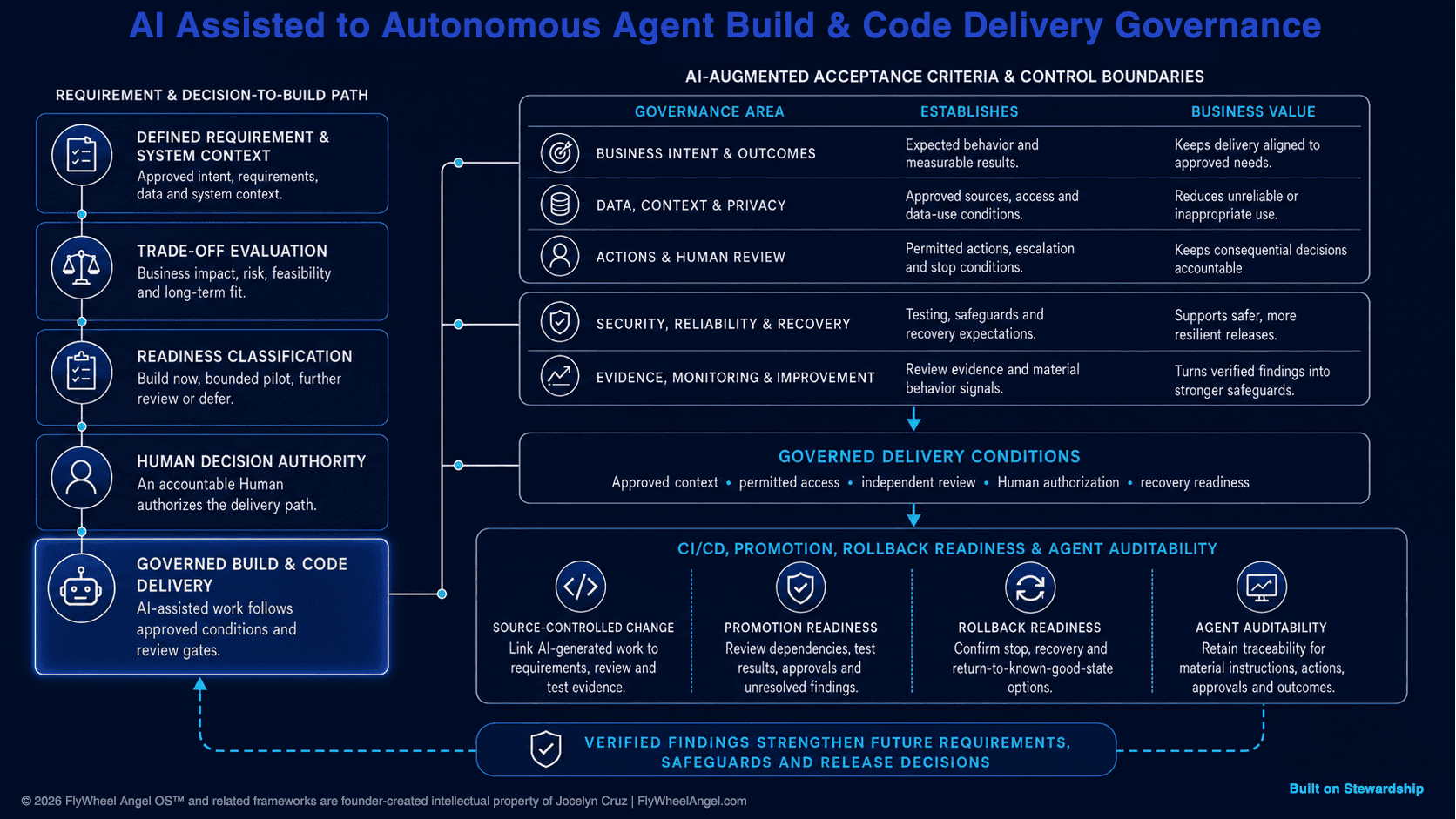
A Governed Path for Production-Impacting AI Work
Approved Intent and System Context
Ground AI-assisted work in an approved business purpose, defined requirements, current architecture, relevant data, system dependencies, security constraints, and acceptance conditions.
This establishes what the change is expected to accomplish and the enterprise conditions it must respect.
Bounded Build Responsibility
Define what the AI capability is authorized to create, revise, access, test, recommend, or deploy. Establish the required checkpoints, escalation conditions, and recovery expectations associated with the work.
Governance depth increases with the change’s risk, autonomy, access, reversibility, and potential downstream effect.
Traceable Change and Accountability
Connect AI-generated and AI-modified work to the approved requirement, change history, responsible owner, review record, validation results, and release decision.
Traceability gives teams the evidence required to understand what changed, why it changed, how it was evaluated, and who authorized it.
Independent Validation
Evaluate functionality, security, permissions, dependencies, data behavior, integrations, regressions, and recovery readiness through a separate assurance path.
Independent assurance tests the work against approved requirements and acceptance conditions and presents material findings to the accountable decision-makers responsible for disposition.
Human Release Authority
Accountable Humans review the evidence, evaluate unresolved findings and exceptions, and authorize promotion, release, rollback, or reassessment.
Architecture, security, quality, operational, and business authorities retain responsibility for decisions within their respective roles.
Release Resilience and Monitored Improvement
Prepare the release path, recovery approach, monitoring expectations, and post-release review before production authorization.
After release, teams monitor system behavior, agent actions, failures, escalations, performance, and business outcomes. Verified findings strengthen future requirements, tests, safeguards, and operating guidance.
Any AI capability that can create, revise, configure, test, deploy, or recommend production-impacting change belongs within architecture governance, quality assurance, security review, release authorization, recovery planning, and post-release monitoring.
FlyWheel connects AI-assisted delivery to the same chain of intent, authority, assurance, evidence, and improvement that governs the wider enterprise lifecycle. As AI autonomy increases, technical accountability, Human release authority, traceability, and recovery readiness remain explicit.
One Governance Foundation Across Enterprise Platforms
Govern AI Across Platforms, Data, Workflows, and Agents
Enterprise AI rarely operates within a single application. Models, agents, data, workflows, integrations, custom applications, and Human decisions extend across mixed enterprise architectures.
FlyWheel provides a common governance foundation for these environments. Approved business intent, accountable ownership, data and context boundaries, defined action authority, independent assurance, Human Decision Authority, traceable evidence, monitoring, recovery, and verified improvement remain connected across the enterprise.
Platform-agnostic refers to a common governance foundation whose implementation is configured for each environment.
Every platform has its own identity model, data architecture, permissions, agent capabilities, integration methods, release process, monitoring tools, and recovery options. FlyWheel adapts governance requirements to those operating conditions while preserving consistent enterprise accountability.
Common foundation, platform-specific application
A platform-specific governance profile can account for:
Identity and access
How people, applications, models, agents, and service accounts receive authority.
Data and context
Which sources AI may use and how quality, privacy, lineage, residency, and grounding are governed.
Actions and integrations
What AI may recommend, initiate, change, or execute across connected systems.
Delivery and release
How requirements, configuration, code, tests, approvals, and production changes are governed.
Assurance and evidence
How outputs and actions are independently evaluated and retained for accountable review.
Monitoring and recovery
How behavior, deviations, failures, Human interventions, rollback, and improvement are managed after release.
Representative enterprise environments
Salesforce and Agentforce
In Salesforce and Agentforce environments, governance can be applied to CRM data and grounding, agent responsibilities, workflow automation, permissions, integrations, custom development, testing, release evidence, and post-release monitoring.
Microsoft Dynamics 365, Power Platform, and Copilot Studio
Across Microsoft environments, governance can address Dataverse context, agents and automated workflows, application permissions, connected actions, environment management, solution promotion, testing, approvals, monitoring, and operational evidence.
ServiceNow Customer Service Management and the ServiceNow AI Platform
In ServiceNow environments, governance can address case and workflow automation, AI-agent responsibilities, enterprise data and knowledge access, action boundaries, Human escalation, change authorization, monitoring, and service-management evidence.
Genesys Cloud CX
In Genesys Cloud CX, governance can address AI-enabled customer interactions, routing, self-service automation, integrations, data use, Human handoff, monitoring, and customer-experience outcomes.
These environments are representative examples of where FlyWheel’s governance foundation can be applied. Final scope depends on each organization’s architecture, platform edition, licensing, region, configuration, connected systems, available features, and approved implementation plan. The examples do not represent vendor endorsement, certification, native integration, or confirmed deployment.
FlyWheel gives enterprises a common governance language across mixed architectures and a disciplined way to adapt controls to each platform’s identity, data, action, release, monitoring, and recovery model. Authority, assurance, evidence, and verified improvement remain connected as technologies, vendors, and use cases evolve.