
A Stewardship-Led Foundation for Enterprise AI
FlyWheel’s direction begins with stewardship: protecting people, decision integrity, and long-term investment through accountable Human authority, traceable decisions, trusted data, independent assurance, and outcomes leaders and customers can rely on.
Together, FlyWheel’s vision, mission, core values, and Human-Centered AI Commitment define the impact it seeks to create, the work it undertakes, the principles governing its decisions, and the responsibilities it accepts toward people affected by AI.
Vision
AI-assisted work advances in alignment with business intent throughout the lifecycle, under accountable Human authority, and toward responsible business impact.
Mission
Orchestrate the movement from business need to measurable outcomes while governing risk, quality, multi-model execution, and evidence-backed decisions.
Core Values
Stewardship, evidence-led trade-offs, trusted data, Human accountability, risk prevention and mitigation, and learning that strengthens the current and next lifecycle.
Human-Centered AI Commitment

FlyWheel Angel OS is grounded in the conviction that AI should remain under accountable Human judgment and be guided by empathy and care. We believe no innovation is complete until the people it affects have voice, protection, and a fair share of the value it creates. We choose AI that expands human capability while preserving human agency, dignity, and security.
See how this commitment applies to the future of work →Featured Perspective · Human-Centered AI
Protecting People in the Age of AI: A Shared Commitment to Dignity, Opportunity, and Security
FlyWheel’s Human-Centered AI Commitment begins with a simple conviction: AI should expand human capability without diminishing human agency, dignity, or security.
In this article, FlyWheel founder Jocelyn Cruz considers what that responsibility means for students, workers, employers, AI developers, investors, and public leaders—and why progress must be measured not only by what AI can do, but by what happens to people when it is deployed.
“No innovation is complete until the people it affects have voice, protection, and a fair share of the value it creates.”
Read: Protecting People in the Age of AI →
Creator of FlyWheel Angel OS
25 Years in Enterprise Technology—
An Architect-Builder Grounded in Stewardship
Jocelyn Cruz has designed, built, governed, and improved enterprise systems for technology companies and organizations across life sciences, healthcare, financial services, education, nonprofit, manufacturing, and retail. These systems have supported revenue operations, financial controls, nonprofit case management, CRM, data, audit, reporting, customer service, and enterprise performance. Her experience includes M&A technology integration, Salesforce transformation, global consolidation, data governance, technical-debt remediation, and delivery recovery.
She created FlyWheel’s product vision, governance framework, Human Decision Authority model, independent-assurance approach, deviation taxonomy, Root Cause Analysis model, and v1.5 product architecture. She is now directing FlyWheel’s continued development, customer evidence, and path to enterprise adoption.
Jocelyn’s Bio in a Glance


Jocelyn’s 25 years across enterprise delivery shaped the stewardship, governance architecture, and Human-centered principles behind FlyWheel Angel OS.
Founder, CAIO and AI SRE—
The Firefighter and Architect of Governed AI
As FlyWheel’s founder, current Chief AI Officer (CAIO) and AI Site Reliability Engineer (AI SRE), Jocelyn splits her time among building the company, leading applied AI governance research and development (R&D), and serving as a modern firefighter and architect of AI execution. She treats an AI deviation not as an isolated mistake, but as a system failure that must be contained, investigated, corrected, independently retested, and converted into a durable prevention control.
Jocelyn personally manages the end-to-end response loop. She determines which failures matter, evaluates their severity and downstream consequences, traces root causes across models, agents, instructions, data, sources, permissions, decisions, and generated artifacts, and designs mitigations that address both the immediate incident and the conditions that allowed it to occur. She translates those findings into FlyWheel’s architecture—designing controls and system boundaries that support detection and investigation, prevent recurrence, mitigate downstream impact, and constrain AI execution—while reserving consequential decisions and release authority for accountable Human review.
In FlyWheel’s current stage, her responsibilities span more than 80% of the functions commonly distributed across an AI governance organization, including AI reliability engineering, quality assurance, model ownership, risk analysis, responsible-AI program leadership, data and KPI governance, security oversight, compliance, and enterprise AI strategy. This hands-on, cross-functional role gives her direct visibility into the silent failure modes that many generative-AI users never see: errors that appear minor in one output but compound across sources, decisions, workflows, and downstream deliverables.
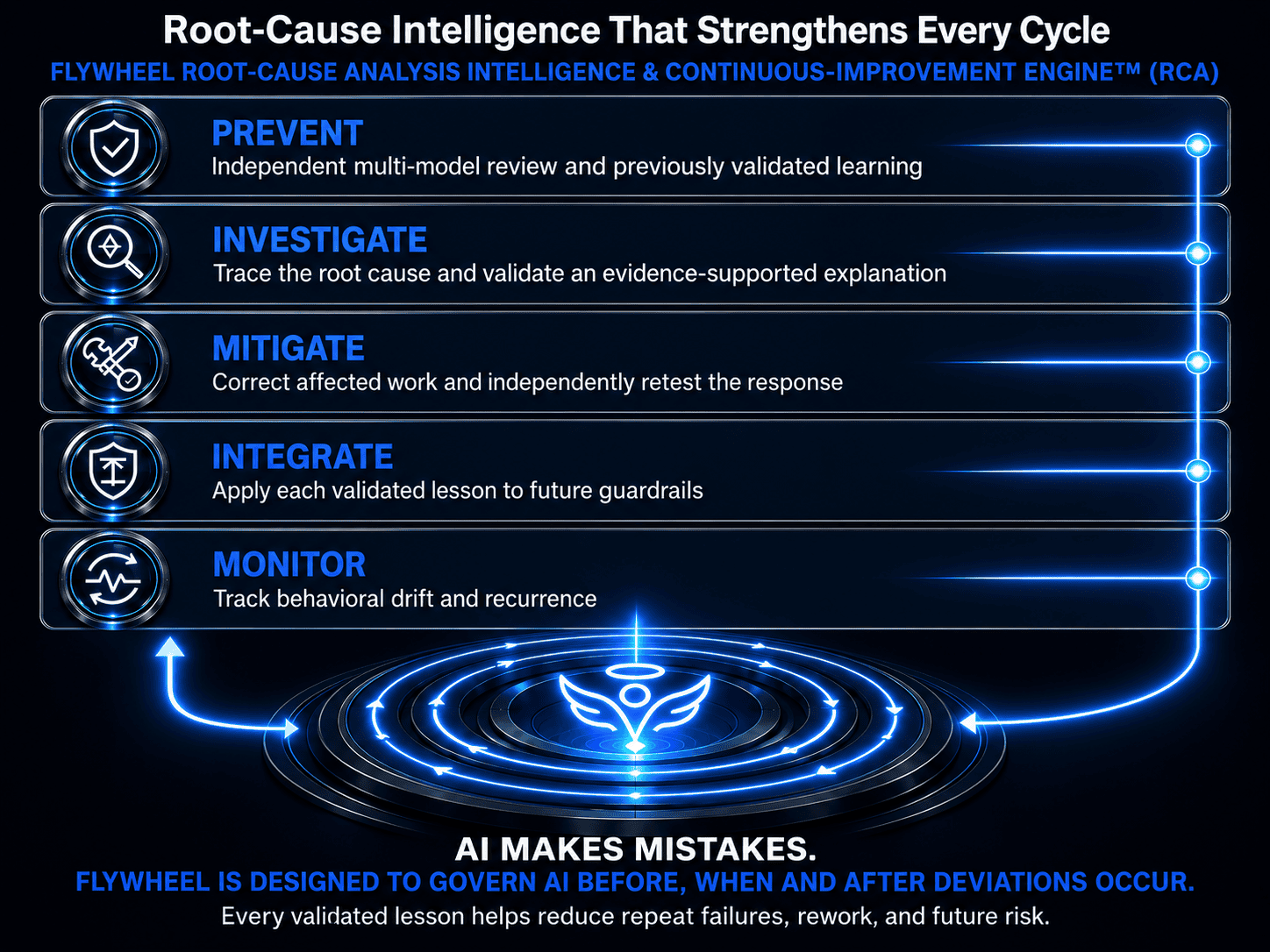
That operating and R&D experience is shaping the FlyWheel Root-Cause Analysis Intelligence & Continuous Improvement Engine™ (RCA). Jocelyn is designing the engine to identify and define systemic deviations, trace their origin and propagation, guide containment and correction, support independent retesting, capture reusable learning, and establish long-term risk-prevention frameworks. The goal is not simply to repair what went wrong, but to strengthen how AI-enabled work is governed, verified, and improved over time.
Built on Stewardship, from Both Sides of the Table
Jocelyn brings 25 years of experience across CRM, digital transformation, data, AI, and enterprise IT delivery, including more than 14 years leading Salesforce-centered implementations and modernization programs. Her background includes consulting leadership roles at LTIMindtree, Wipro, and Infosys, together with client-side and advisory experience supporting Cisco Systems, Cisco Foundation, Intuit, Stryker, Becton Dickinson, Humane Society Silicon Valley, and Harvard Business School—among others.
That dual vantage point, reinforced by her role as a best-practice champion, gives her direct knowledge of business stakeholder expectations, consulting delivery pressures, Center of Excellence (CoE) standards, implementation trade-offs, data and governance requirements, end-to-end software development lifecycle (SDLC) delivery, and long-term platform health. She has championed data integrity and quality through defined standards, audits, and remediation. She understands what strong enterprise delivery requires: complete validated requirements, engaged stakeholders, business-aligned solution architecture, disciplined governance, transparent decisions, accountable ownership, and measurable business impact.
That experience shaped FlyWheel’s defining principle: Built on Stewardship. Stewardship means protecting people, making thoughtful decisions, and taking responsibility for creating long-term value and a governed path from business intent to measurable outcomes that leaders and customers can trust.
Earned Insight and Visionary Origin
Across enterprise implementations, modernization initiatives, M&A consolidations, and delivery-recovery programs, Jocelyn saw the same failure pattern emerge before release: superficial discovery, unvalidated requirements, fragmented backlogs, misaligned roles, weak data integrity, technical debt, over-customization, unclear ownership, and governance applied too late.
She saw the effects directly—agents navigating disconnected tools during customer calls, managers unable to rely on reports and dashboards, fragmented customer data preventing agents from accessing a reliable 360° customer view, delivery teams absorbing avoidable rework, and leaders lacking the KPI instrumentation needed to measure ROI.
Jocelyn responded by combining end-to-end systems thinking with rigorous, hands-on solution architecture and build—raising delivery standards from discovery through release: mapping business processes, user workflows, data models, integrations, compliance obligations, reporting needs, and performance measures before solution design; configuring and building CRM and data capabilities, workflows, automations, integrations, reports, and dashboards; supporting testing, release, and remediation; capturing tribal knowledge in validated requirements and acceptance criteria; evaluating trade-offs against business impact, scalability, feasibility, and long-term platform direction; and connecting delivery decisions to accountable owners and measurable outcomes.
That experience revealed a defining principle: enterprise systems earn trust when business intent, architecture, data, decisions, validation, and accountability remain connected throughout the lifecycle.
She recognized that AI would amplify these failures as models and Agents gained greater responsibility and access across enterprise workflows. That insight led to FlyWheel: one governed lifecycle connecting business intent, approved requirements, authorized execution, independent validation, Human Decision Authority, release evidence, correction, Root Cause Analysis, and continuous improvement.
Founder Conviction—From R&D and Solution Architecture to Enterprise Scale
Jocelyn’s leadership of FlyWheel is both strategic and operational. As Founder and CAIO, she leads FlyWheel’s applied R&D and defines the company’s product direction, governance architecture, Human Decision Authority model, risk principles, and standards for responsible enterprise adoption. As its current AI SRE, she works directly inside the failure-and-improvement loop—investigating deviations, evaluating downstream consequences, and solving for prevention and mitigation through FlyWheel’s architecture design, turning lessons from AI execution into stronger product requirements, system controls, and long-term prevention capabilities.
The integration of company leadership, R&D, and governed execution is intentional. It grounds FlyWheel’s product and operating model in observed AI failure modes, enterprise risk, and measurable governance needs—not abstract principles alone.
Jocelyn translates those findings into solution architecture that connects clear decision authority, bounded responsibilities, independent assurance, traceable evidence, accountable Human oversight, correction, and continuous improvement across the lifecycle.
FlyWheel’s approach to enterprise scale is anchored in architecture and operating discipline: consistent standards, explicit decision rights, evidence-led accountability, and stewardship that preserve governance integrity across teams, systems, and enterprise environments.
Selective Investor Engagement
Investment Alignment for FlyWheel’s Next Stage
FlyWheel is selectively engaging with qualified pre-seed investors who recognize the urgency of governing AI-augmented enterprise delivery and the venture-scale potential of a focused enterprise governance product.
Investors with relevant experience in enterprise software, Applied AI, B2B SaaS, and early-stage product and company development are invited to request a confidential conversation with founder Jocelyn Cruz.
Request an Investor Conversation