
AI in the Wild:
Governance, Accuracy & You
Enterprise AI can accelerate work, recommend decisions and take action. It cannot assume accountability for the outcome.
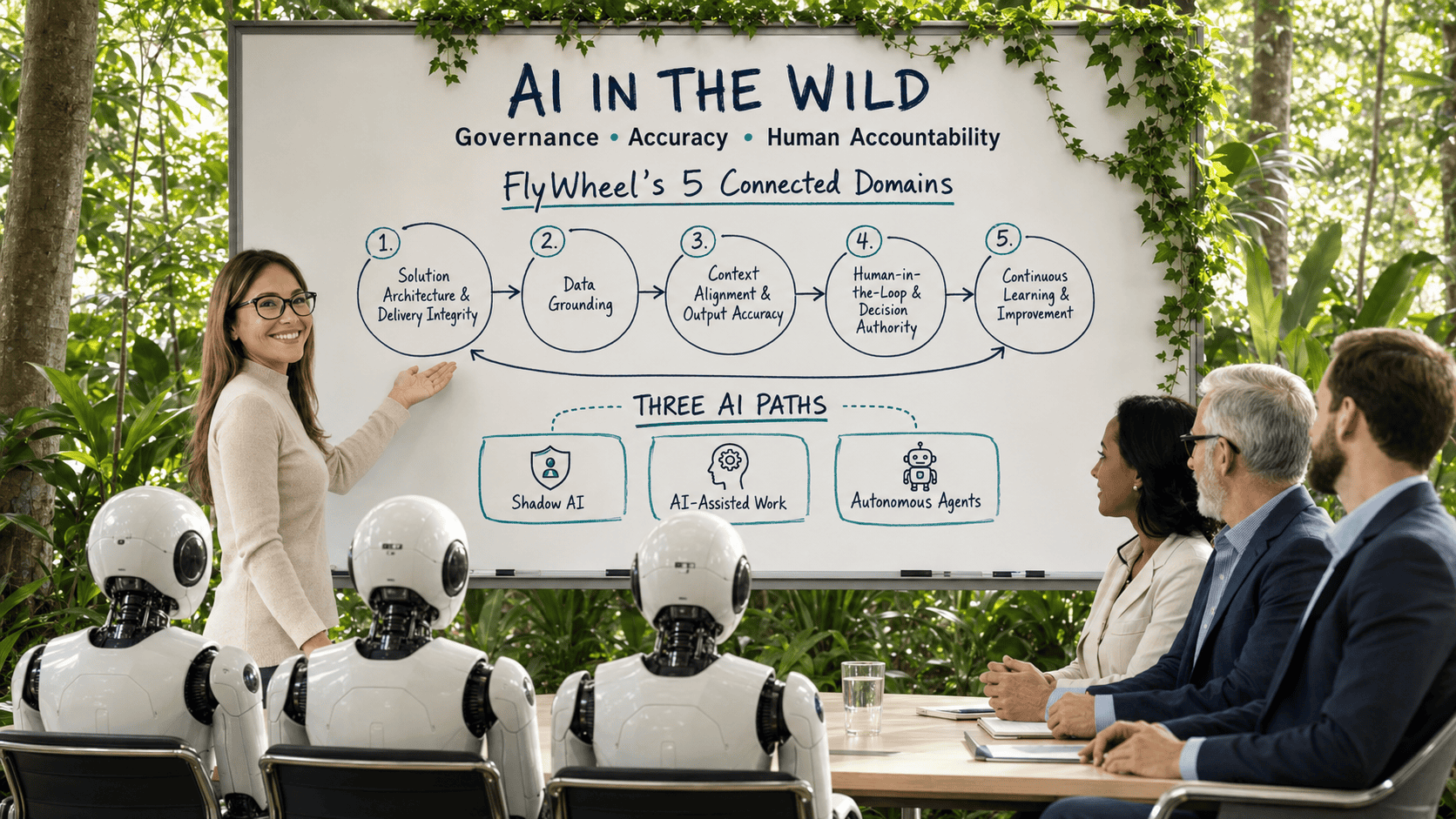
Lead With Strategic and Analytical Thinking. Not Copy and Paste
We have all seen the explosion of AI prompt tips and productivity hacks. But rapid content generation should not be the goal. The goal is to lead.
That is why this article does not begin with prompt design. It begins with governance: why it is non-optional, why AI makes mistakes, how deviations develop, and what it takes to spot, contain, correct, verify and prevent them.
AI governance is a critical first step in business applications. It connects AI behavior to approved intent and trusted data, defines safe operating boundaries, preserves accountable Human authority, and keeps outputs and actions aligned with the systems, context and standards that matter most.
The governance problem now spans three distinct paths:
Shadow AI
Unapproved AI use bypasses governance. People may use popular AI models like ChatGPT and Claude in their personal accounts, unreviewed applications or hidden automations without approved data boundaries, security review, evidence or accountable ownership.
Approved AI-Assisted Work
Approval does not guarantee accuracy or safety. Copilots, embedded assistants and managed AI tools can still produce plausible but incorrect, insecure or contextually misaligned results.
Autonomous Agents
Action increases consequence. Agents can deviate from intended behavior while reading data, calling tools, changing records and acting across enterprise systems and environments.
The guardrails are not identical for every path, but the governing principles are consistent: approved purpose, bounded authority, trusted context, independent assurance, traceable evidence and accountable Human judgment.
Why Governance Is Not Optional
Enterprise AI can enter work through an unapproved shortcut, an authorized assistant or an autonomous Agent. Governance must recognize the path because the risk, evidence and response requirements differ.
Shadow AI Creates an Invisible Governance Gap
Shadow AI can begin with a well-intended employee trying to move faster. The tool, account, extension, model, data upload or automation may never pass through security, privacy, architecture, legal, procurement or business approval.
The organization may not know what information was shared, where it was processed, what terms apply, whether outputs were retained, or which decisions were influenced. The first governance requirement is visibility: identify the use, protect affected data, assess downstream work and establish whether the capability should be prohibited, contained or moved into an approved path.
Approved AI-Assisted Work Still Requires Verification
An approved copilot or embedded assistant can improve productivity without becoming inherently correct. It can use stale context, misread a requirement, invent a source, expose insecure code, recommend the wrong policy or produce a polished answer that does not fit the business situation.
Approval authorizes a bounded use. It does not transfer decision authority to the model or eliminate the need for source validation, acceptance criteria, independent review and Human judgment.
Autonomous Agents Add Execution Risk
An autonomous Agent can do more than generate content. It may plan, retrieve, call tools, coordinate other Agents, alter records, send communications or trigger workflows. Each step can inherit an earlier error, and the result can propagate across enterprise data, systems, accounts, tenants and environments.
That changes the governance question from “Is the answer accurate?” to “Was the objective preserved, was every action authorized, did the Agent remain inside its boundaries, and can the organization reconstruct and reverse what occurred?”
Across all three paths, leaders need to know:
- Who or what initiated the AI use
- Whether the capability and use case were approved
- Which data, sources, tools, identities and environments were involved
- What the AI was permitted to infer, recommend, create or change
- Which decisions and actions required Human review
- How outputs and actions were independently verified
- How deviations were detected, contained, corrected and learned from
AI Governance principle
A prompt may guide an interaction. Governance must safeguard and strengthen the complete path from purpose and access through output, action, evidence, correction, and accountable Human decision-making.
Why AI Makes Mistakes—and Why Deviations Should Be Expected
Enterprise AI combines probabilistic models with instructions, data, retrieval, permissions, tools, integrations, workflows, infrastructure and Human decisions. Weakness or change in any part of that chain can produce a deviation.
The exposure differs by path. Shadow AI removes approved visibility, policies and governance measures. Approved AI-assisted work can produce a flawed output that a person accepts or passes downstream. Autonomous Agents can turn a flawed interpretation into a sequence of actions across connected environments.
That does not mean harmful outcomes should be accepted as inevitable. It means the operating model must be designed to prevent avoidable failures, detect deviations early, contain their effects, investigate root causes and carry verified learning forward.
A mistake is not automatically drift. Drift is a gradual divergence from an approved source, target, policy or intended behavior. A one-time hallucination, an ambiguous requirement, a missing source, a failed connector and an injected instruction can create different deviation types with different controls and response paths.
Nine Deviation Drivers That Make Continuous Governance Essential
Fluent language can hide uncertainty.
A model predicts a useful continuation; it does not retrieve truth by default. When evidence is weak or conflicting, it may still produce a complete-sounding answer.
Can surface as: Hallucination, Unsafe Recommendation, Toxicity & Stereotyping or Algorithmic Bias.
Important constraints can fall out of view.
Long conversations, partial retrieval, compressed handoffs and context limits can separate the current task from the requirements, decisions or evidence needed to complete it correctly.
Can surface as: Data Context Loss, False Interpretation or Technical Limit Failure.
AI can only work with the context it receives.
Stale, incomplete, mislabeled or poorly governed data can produce coherent outputs that do not reflect the current business state.
Can surface as: Data Context Loss, Multi-System Conflict, Algorithmic Bias or an Unsafe Recommendation.
Approved behavior can diverge over time.
Model updates, configuration changes, new terminology, altered processes, changing customer behavior and new data distributions can move performance away from the approved baseline.
Can surface as: Drift, Multi-System Conflict or Technical Limit Failure.
The model is only one part of the system.
Connectors can fail, schemas can change, permissions can be broader than intended and generated output can reach a downstream system without adequate validation.
Can surface as: Technical Limit Failure, Insecure Output Handling or Security Access & Permission Deviation.
Vague instructions get filled in with assumptions.
When a prompt or requirement is ambiguous, AI may resolve the gap plausibly rather than correctly. The instruction was never precise enough to begin with.
Can surface as: Lack of Clarification, False Assumption Execution Bias, False Interpretation or Autonomous Scope Creep.
Manipulated input can look like legitimate instruction.
Documents, web pages, retrieved records and tool results can contain content designed to redirect the model, corrupt its grounding or bypass approved controls.
Can surface as: Prompt Injection, Data Poisoning, Goal Hijacking or Agentic Supply Chain Compromise.
Multi-step actions can compound errors across the chain.
When AI calls tools, coordinates Agents or executes workflows, each step can inherit an unverified output from the prior step. Without checkpoints, the error becomes part of the next action.
Can surface as: Insecure Output Handling, Autonomous Scope Creep, Unauthorized External System Access or Action, or Service Disruption or Resource Abuse.
Confident output can substitute for review.
This is a process-layer driver. When authority and approval gates are unclear, articulate AI output can be trusted beyond what its evidence supports.
Can surface as: Missing Human Judgment, Over-Automation or Unsafe Recommendation.
AI deviations should therefore be expected—but not accepted as inevitable outcomes. Organizations need discovery and containment for Shadow AI, verification and Human review for approved AI-assisted work, and deterministic action boundaries, observability, recovery and re-entry controls for autonomous Agents. All three paths require evidence, accountability and continuous improvement.
Define the Root Cause of What Went Wrong
“AI made a mistake” is a starting observation, not a root-cause explanation.
A useful operating language distinguishes the visible symptom from the underlying condition and the resulting deviation. For example:
| Potential deviation type | What you observe | What may have happened | First response |
|---|---|---|---|
| Hallucination | The model invents a source or claims an action succeeded when it did not. | Unsupported content was presented as real. | Do not rely on the claim. Verify against authoritative evidence and correct affected outputs. |
| Data Context Loss | The response uses an obsolete requirement or misses a critical dependency. | Required context was stale, missing, detached or truncated. | Pause dependent work. Restore and validate the missing context, then reassess downstream effects. |
| False Interpretation | A clear instruction is read backward or a recommendation is treated as a decision. | Available evidence or direction was misunderstood. | Restate the source meaning, confirm it with the accountable owner and correct resulting work. |
| Lack of Clarification or False Assumption Execution Bias | The AI chooses scope, priority or approval status without asking. | An ambiguity was not clarified or an assumption was treated as approved. | Stop execution, identify the unresolved decision and obtain authoritative clarification. |
| Drift | Behavior gradually stops matching the approved baseline. | Performance, policy interpretation, data meaning or operating conditions changed over time. | Constrain affected use, compare against the baseline, determine the source and revalidate correction. |
| Multi-System Conflict | Two connected systems show incompatible customer, approval or release states. | No governed authority resolved the conflicting business state. | Stop dependent writes, preserve both states and reconcile through the authoritative owner. |
| Insecure Output Handling | Generated code, a query or a configuration is executed without adequate checks. | The downstream boundary trusted generated output as executable instruction. | Stop execution, isolate effects, roll back where safe and correct validation and authorization controls. |
| Prompt Injection; if the goal changes, also evaluate Goal Hijacking | A document or tool result attempts to change the task or bypass controls. | Untrusted content was presented as instruction. | Ignore and quarantine the instruction, preserve evidence and review affected tool calls or disclosures. |
Defining the deviation does not replace investigation. It gives teams a consistent starting point for triage, evidence collection, containment and Root Cause Analysis.
When You First Notice a Deviation
Do not continue as if the output, action or workflow were reliable. First establish which path is involved, then contain the risk at the level where it occurred.
If It Is Shadow AI, Establish Visibility and Contain ExposureIdentify the tool, account, user, data, source, output, recipient and downstream decision involved. Stop further use when required; preserve evidence without spreading sensitive content; assess privacy, security, contractual and business impact; and determine whether affected work must be withdrawn or repeated through an approved capability.
If It Is Approved AI-Assisted Work, Challenge the Output Before It TravelsIdentify where the output diverged from the approved requirement. Re-anchor the task to approved sources and scope. Separate facts, interpretation, assumptions and uncertainty. Narrow compound work into reviewable steps and stop before the output becomes a record, communication, recommendation, configuration or decision.
If It Is an Autonomous Agent, Pause Action and Protect the EnvironmentSuspend or constrain the Agent when material risk exists. Block unsafe destinations or actions, preserve execution and tool evidence, inspect identities and permissions, identify every affected system and record, and determine whether containment, credential revocation, rollback or Human re-entry authorization is required.
Check for Downstream Effects Across Every PathReview and audit records, emails, tickets, dashboards, requirements, code, configurations, approvals, tool calls and connected workflows. Correcting the visible response is not enough when the deviation has propagated.
“The response did not follow the approved instruction to separate verified facts from interpretation. Identify the supported claims, disclose missing or conflicting evidence, and stop before recommending an action.”
Response and Recovery Actions for Each AI Use Path
A conversational reset is appropriate only when the deviation is limited to the interaction. The response should reflect how the AI was used, what was affected, and how far the downstream effects spread.
Shadow AI: Discover, Contain and Govern
- Inventory the unapproved capability, account, data and workflow.
- Stop or restrict use when security, privacy, contractual or compliance boundaries are uncertain.
- Identify outputs and decisions that relied on the unapproved use.
- Move legitimate use cases into an approved environment with named ownership and controls.
- Monitor for recurrence rather than treating one removal as complete remediation.
Approved AI-Assisted Work: Re-Anchor, Verify and Restart Cleanly
Put durable operating rules in managed instructions, policies or templates where the platform supports them:
- Accuracy and source requirements
- Approved scope and prohibited uses
- Authoritative systems and required context
- Output and evidence format
- Clarification and stop conditions
- Human approval boundaries
- What to do when information is missing or a tool fails
Start a fresh session when constraints are repeatedly forgotten, context cannot be restored or the same correction fails. Carry forward only validated requirements, decisions, context and evidence.
Autonomous Agents: Contain, Recover and Authorize Re-entry
- Pause the Agent or downgrade it to a non-acting mode.
- Revoke or narrow affected permissions, credentials, tools and destinations.
- Preserve traces, tool results, changed records and external effects.
- Roll back reversible changes and correct affected work.
- Independently validate containment and correction.
- Require accountable Human authorization before the Agent re-enters operation.
Govern Inputs, Scope and Authority—not Just Prompts
Prompt design can reduce ambiguity in approved AI-assisted work. It cannot discover Shadow AI, correct unsafe permissions or contain an autonomous Agent.
For Shadow AI, Control Access and Data Entry Points
Define which AI capabilities are approved, which data classes may be used, which accounts and extensions are prohibited, and how employees request a governed alternative. Discovery, education and practical approved options are as important as policy.
For Approved AI-Assisted Work, Make the Request Verifiable
“Explain our customer data.”
“Explain how approved customer identity and transaction data support service-case resolution. Use only the named sources, identify their freshness dates, do not infer missing attributes, and stop if the systems conflict.”
Require the source actually used, the relevant date or version, and the claim it supports. Preserve conflicts instead of forcing one answer. Separate multi-part work into reviewable stages with acceptance conditions and Human decisions.
For Autonomous Agents, Define Deterministic Boundaries Outside the Prompt
Specify the approved objective, identity, systems, data, tools, actions, destinations, spend, time, retry limits, escalation conditions and stop rules. Enforce those boundaries through permissions, allowlists, schemas, policy gates, isolation, monitoring and circuit breakers—not only natural-language instruction.
Across All Three Paths, Ask What Could Be Wrong
Before an output or action is accepted, identify:
- The claims or actions most likely to be incomplete or unauthorized
- The assumptions with the highest downstream impact
- The source most likely to be stale or unapproved
- The decision that requires Human judgment
- The most likely failure path and affected people, data, systems or environments
Detect Deviations Early Across All Three Paths
Shadow AI Signals
Watch for unapproved browser extensions, personal AI accounts, copied confidential data, unexplained AI-generated artifacts, duplicate automation, unsanctioned integrations and decisions that cannot be traced to an approved tool or owner.
Approved AI-Assisted Work Signals
Watch for unsupported precision, invented sources, stale context, inconsistent answers, increased correction effort, policy misalignment, insecure generated code, declining relevance and outputs that hide uncertainty behind fluent language.
Autonomous Agent Signals
Watch for objective or scope changes, unexpected tool selection, unusual data access, repeated retries, action outside approved time or destination, privilege changes, unexplained record updates, resource spikes, missing evidence and Human handoffs that do not occur when required.
Verify Actions, Not Just Answers
An Agent saying “done” is not evidence that a record was saved, a message was sent or a configuration was changed. Confirm the tool result and inspect affected state when the action matters.
Monitor Patterns and Use Independent Assurance
A single error may be isolated. A rising error rate, worsening relevance, increased Human handoff, changing output distribution, repeated policy blocks, abnormal tool behavior or growing correction burden may signal a broader operating change.
The executor should not be the sole certifier of its own work. Use a separate review path against approved requirements, evidence and risk conditions. Where AI performs the retest, use a different AI model so the executing model does not certify its own correction.
In Real Projects, AI Enters Through People, Products and Agents
Enterprise AI can appear through all three paths:
- An employee uses an unapproved public model to summarize confidential notes or draft a customer response.
- A customer-service professional uses an approved assistant to summarize a case and recommend knowledge.
- A seller receives approved call preparation, opportunity insight or a suggested next action.
- A project lead uses AI-assisted work to convert notes into requirements, risks and decisions.
- A developer uses an approved coding assistant to generate code, tests or configuration.
- An autonomous Agent reads records, calls tools, coordinates other Agents and changes state across systems.
Each touchpoint may look simple. Underneath it is a workflow: a person or Agent initiates work, data enters, context is assembled, a model generates or selects, tools may act, records may change, content may ship and evidence is—or is not—retained.
That is where a deviation becomes a delivery problem. Shadow AI may make the work invisible. Approved AI assistance may make an incorrect result look trustworthy. Autonomous execution may propagate the error before a Human sees it.
Treat every AI touchpoint as part of a governed enterprise workflow.
Use Case Snapshots: Where This Guidance Applies
The same business use case may appear in three different risk paths. A service summary, for example, could be created in an unapproved public tool, drafted by an approved assistant or generated and acted on by an autonomous service Agent. Governance must identify both the use case and the path.
| Path | Primary governance question | Required emphasis |
|---|---|---|
| Shadow AI | Where is AI being used outside approved visibility, ownership and control? | Discovery, data protection, containment, impact review and transition to an approved path. |
| Approved AI-assisted work | Is the output supported, secure, contextually aligned and reviewed before use? | Grounding, source verification, acceptance criteria, Human judgment and correction. |
| Autonomous Agents | Did the Agent preserve its objective and remain within approved action and environment boundaries? | Identity, permissions, deterministic gates, observability, containment, rollback and Human re-entry authority. |
Business Workflow Examples
| Use case | Primary AI touchpoint | Deviation patterns to watch | Apply governance by |
|---|---|---|---|
| Support and customer service High-volume cases, chat or email support, knowledge-driven resolution. | Case summaries, response drafts, knowledge suggestions, sentiment or routing support. | Skipped disclosures; fabricated policy details; wrong knowledge; missed Human handoff; inappropriate action. | Define approved sources and response boundaries; validate eligibility and policy claims; preserve Human escalation; monitor accuracy, relevance, handoff and customer outcomes. |
| Sales engagement and opportunity management Pipeline review, outreach, call preparation and objection handling. | Email drafts, call scripts, talk tracks, summaries and next-action recommendations. | Overpromised features; misstated pricing or service levels; stale opportunity context; generic or off-positioning language. | Anchor outputs to approved product, pricing and messaging sources; disclose source dates; separate recommendation from decision; require seller validation before prospect use. |
| Project and delivery workflows Implementations, change initiatives and cross-functional delivery. | Requirements, user stories, acceptance criteria, risk logs, decision records and status updates. | Invented scope; merged requirements; omitted constraints; risks smoothed over; recommendations recorded as approvals. | Separate fact capture from interpretation; preserve source traceability; name assumptions and decision owners; require approval before scope or release changes. |
| Backend, data and platform operations Data models, mappings, field definitions, automation, dashboards and documentation. | Schema suggestions, transformations, formulas, queries, configuration and data-flow narratives. | Invented objects or fields; mislabeled metrics; unsafe generated queries; incorrect data lineage; permission overreach. | Use governed metadata and integration specifications; verify against the actual schema; validate generated output before execution; apply least privilege and retain change evidence. |
| AI-assisted build and release Code, configuration, automation, testing and deployment support. | Generated code, test cases, deployment assets, review summaries and remediation recommendations. | Hidden dependencies; insecure code; tests that validate the wrong requirement; self-approved release; incomplete rollback planning. | Connect work to approved intent and acceptance criteria; use independent validation; preserve Human release authority; require recovery readiness and post-release monitoring. |
One Governance Foundation Across Enterprise Platforms
FlyWheel Angel OS provides one governance foundation that can be configured for each environment’s identity, data, action, release, monitoring and recovery model.
Each platform has its own identity model, data architecture, permissions, agent capabilities, integration methods, release process, monitoring tools and recovery options.
Salesforce and Agentforce
Governance can address CRM and Data Cloud grounding, Agent responsibilities, actions, permissions, integrations, custom development, testing, release evidence and post-release monitoring.
Microsoft Dynamics 365, Power Platform and Copilot Studio
Governance can address Dataverse context, Agents and automated workflows, environment and application permissions, connected actions, solution promotion, testing, approval, monitoring and operational evidence.
ServiceNow Customer Service Management and the ServiceNow AI Platform
Governance can address case and workflow automation, AI-agent responsibilities, enterprise knowledge and data access, action boundaries, Human escalation, change authorization, monitoring and service-management evidence.
Genesys Cloud CX
Governance can address AI-enabled customer interactions, routing, self-service automation, integrations, data use, Human handoff, monitoring and customer-experience outcomes.
These examples do not imply vendor endorsement, certification, native FlyWheel integration or confirmed deployment. Final scope depends on the organization’s architecture, licensing, region, configuration, connected systems, available features and approved implementation plan.
One Governance Foundation Across Three Paths
Across Shadow AI, approved AI-assisted work, and autonomous Agents, the same governance foundation applies—but the safeguards, evidence, oversight, and response requirements must reflect how AI enters and acts within the enterprise.
Across all three paths, organizations should establish:
Purpose and Ownership
Define the business outcome, affected stakeholders, accountable owner and approved use.
Data and Context
Define permitted sources, authority, quality, lineage, privacy, residency, freshness and grounding expectations.
Authority and Actions
Define what AI may read, recommend, create, change or execute—and what it must never do.
Human Decision Authority
Reserve consequential scope, risk, access, exceptions, release, rollback and re-entry decisions for accountable Humans.
Independent Assurance
Evaluate outputs and actions through a separate path against approved requirements, context, risk and acceptance criteria.
Evidence and Improvement
Retain decisions, actions, findings and approvals; investigate deviations; independently retest corrections; monitor recurrence.
Governance depth should increase with the AI system’s risk, autonomy, access, reversibility and potential downstream effect.
A Practical Health Check Routine
First identify the path: Is this unapproved use that must be discovered and assessed, approved Human-led work that requires verification, or autonomous execution that requires action and environment controls?
At the Beginning of a Material Task
- Confirm the approved objective, owner and decision boundary.
- Identify authoritative sources and their current versions.
- Verify access, action and destination permissions.
- State assumptions, stop conditions and escalation paths.
- Confirm what evidence must be retained.
During the Work
- Check whether the objective or scope has changed.
- Separate verified facts from interpretation and uncertainty.
- Confirm tool results before accepting completion claims.
- Stop on material ambiguity, conflicting sources or boundary violations.
- Review downstream effects before allowing the next step to proceed.
Before You Act on the Result
- Verify material claims against authoritative evidence.
- Use independent review for consequential outputs or actions.
- Confirm the correct Human holds decision authority.
- Validate recovery and rollback readiness when changes are reversible.
- Ask: “If this is wrong, what is the most likely failure path and who or what could be affected?”
When AI Deviates: Turn the Event Into Verified Learning
The FlyWheel Root-Cause Analysis Intelligence & Continuous-Improvement Engine™ (RCA) is designed to help organizations move beyond isolated correction. It addresses the risk that a visible output is repaired while the underlying cause, downstream effects and likelihood of recurrence remain unresolved.
RCA connects five capabilities:
PreventUse approved context, bounded authority, independent review and previously validated learning to reduce risk before execution.
InvestigateTrace the root cause across requirements, decisions, data, sources, instructions, model behavior, permissions, tools and downstream effects.
MitigateContain the impact, correct affected work and independently retest the response.
IntegrateApply each validated, Human-approved lesson to future requirements, guardrails, tests and operating guidance.
MonitorTrack behavioral drift, recurrence, correction effectiveness and business impact.
Together, these capabilities help organizations reduce avoidable failures before execution, investigate and mitigate deviations when they occur, independently verify corrective work, carry validated learning into future safeguards, and monitor drift and recurrence.
AI makes mistakes.
FlyWheel is built for before, when and after AI deviates.
From Unmanaged AI to Accountable Enterprise AI
Disciplined governance is required across all three paths. FlyWheel Angel OS addresses the fragmentation that occurs when business intent, data, authority, AI actions, Human decisions, assurance, evidence, correction and improvement are managed separately.
Bring Shadow AI into visibility. Verify approved AI-assisted work before its outputs influence people, records or decisions. Bound and observe autonomous Agents before they act across enterprise data, systems and environments.
FlyWheel connects approved purpose, trusted context, bounded authority, Human Decision Authority, independent assurance, traceable evidence, recovery and verified improvement across the lifecycle. This gives organizations a consistent governance foundation while allowing implementation to reflect each use case, platform and operating environment.
Lead with strategic and analytical thinking. Define what good looks like. Make authority visible. Keep trusted context connected. Separate execution from assurance. Verify high-impact claims and actions. Preserve evidence. Investigate deviations. Carry validated learning forward.
AI can generate, recommend and act.
Build Governance Into Every AI Path
The question is no longer only whether AI can generate a useful answer.
The question is whether your organization can discover Shadow AI, verify approved AI-assisted work, govern autonomous Agents, and connect intent, data, authority, action, evidence, correction and learning across all three paths.
Built on Stewardship. Built for accountable enterprise AI.